Osama bin Laden has been killed. A sense of awe and resolution may pervade the country, but I am unsettled about the aftermath. It’s not because of the pro-USA chanting by crowds which carries a whiff of celebrating on people’s graves. We know that this brings closure to a manhunt that led to two wars in Iraq and Afghanistan and thousands of deaths. It also gives credibility to Obama’s administration and affirms his strong hand on foreign policy.
The unease comes from the gnawing thought that once we captured bin Laden, should we have brought him to trial? I realize that there are tortuous, international legal laws that surround such a decision, and that much of this would have been considered by the President’s advisors. And yet it raises the broader question:
What is the best way to deal with a vanquished enemy? Let’s see what the Arts have to say about this.
With Tony season, new shows are blooming on the Great White Way. Catch Me If You Can is the creation of Marc Shaiman and Terence McNally who shepherded the film to musical conversion of The Full Monty. The show follows the true-story, narrative of the movie – the tale of a teenage con artist, Frank Abagnale, who through forgery, wit and luck becomes a pilot, physician and lawyer while embezzling millions of dollars. The show is a gift of 1960’s style – a time when air hostesses were glamorous, bank tellers were trusting, and martinis were plentiful.
Yet the production lacks novelty in the story-telling. We know where the characters are landing before the plane leaves the gate. Kerry Butler’s fiancé to Abagnale is one character altered from the movie and yet her part is relegated to the second half and is given one big song (a waste of her talent). There are points when the production sizzles – Leo Norbert Butz’ portrayal of the detective Carl Hanratty who pursues Abagnale like a modern day Javert is pure joy when he breaks out into song. The obsession leads to eventual apprehension of his foil, and the twist is that instead of putting him in jail, he takes pity on the boy and recruits him to help catch other forgers; a pleasing resolution to a comfortable albeit not very challenging evening.
War Horse, a transplant from London’s National Theater, brings to life through breath-taking puppetry the story of a boy that loses his beloved riding horse to the vagaries of World War I. The plot is simple – boy meets horse, boy loses horse, boy finds horse again – but the staging elevates the storyline into a meta-physical world involving pastoral bliss and horrific fighting. The central character is the horse, Joey, portrayed by three actors who are immediately visible and yet blend into the soul of the animal so perfectly they assimilate into one creature. Joey’s emotions and struggles are real beyond anthropomorphism; one believes his longing to live and see his master again. This should be an easy winner at the Tonys.
There is no surfeit of enemies in this play – Germans and English soldiers fighting a tired war involving, unkind fathers and military leaders wrapped in their ego-driven ambitions. The combatants show little pity in defeating their foes; in fact they can only escape self-examination of their deeds, by painting each other as foreign elements bent on destruction. The true adversary is war itself, because it throws apart loved ones – daughters from mothers; husbands from wives, boys from their horses. No one wins in this slide to annihilation, and the only survivor is the hope of an eventual end.
Tony Kushner’s new play, The Intellectual Homosexual’s Guide To Capitalism And Socialism With A Key To The Scriptures (IHo for short) is as dense and long as the title with a four hour run time. Somehow the writing and acting soar despite the weight of such a premise. A father, Gus, brings together his family in Brooklyn to gain communal consensus on his committing suicide. Gus is a socialist, long shoreman who has toiled for the recognition of the common man’s labor, only to be facing a world where all that effort has been erased and forgotten. His disillusionment with his children and more importantly himself, leads him to the decision of self-immolation. The ensemble is winning and transports the show surprisingly quickly with occasional lapses into inscrutable erudition.
For the father, the foe he is fighting is himself. He can no longer live in a world which has given up on his manifesto, and as we later find out, where he has betrayed his own ideals. In his fight for workers’ rights, he made his own pact with the devil. He was able to achieve the victory of guaranteeing a worker’s income after retirement demonstrating that laborers own the value of what they create. But to garner this win, he gave up on his ideal of union for all people, since the salary was given only to certain individuals. The rest of the workers union were eventually laid off and replaced. Gus has never been able to live with this compromise of principles, and his solution is to find solace in death.
Unlike the fairy-tale ending of Catch Me if You Can, with the capture of Osama, it would be idealistic to think that he would partner with the US to stop terrorism. Although in today’s Op-Ed in the New York Times, Nicholas Kristof writes that Richard Holbrooke was trying to accomplish a similar strategy, by creating a peace deal with influential members of the Taliban.
Instead, we seem to have taken the “eye for an eye” path. Osama would not have thought twice to conduct on his own enemies a similar exercise as the US did, in other words, send emissaries to a foreign country and kill people in their homes or at work. In fact, he repeatedly carried out this terrorism. But as we saw in War Horse, the true enemy is the warring itself. Continued retributive actions leave collateral damage making the entire world blind. In many cases, this is the efficient and realistic path to take, but it demands questioning whether there is a way to elevate ourselves out of these no-win situations.
The elusive solution is a twist on the golden rule: to treat the enemy, the way we would want to be treated if the situation were reversed. By treating Osama the way that he has treated us in the past – without remorse, pity or mercy –we are like the Father in IHo, giving up a little of our moral high ground to achieve the goal of bringing justice to the country. We can claim this as an act of self-defense, but it still leaves me unsettled.
May 15, 2011
Sunday, May 15, 2011


Sunday, March 27, 2011
Some thoughts on… Exiting Gracefully
The spring awakening of people-led revolutions in the Middle East is wondrous to behold. The public taking control of their future in Tunisia and Egypt with minimal violence is admirable. The ongoing conflicts in Libya, Syria, Bahrain and Yemen are still playing out.
It is fascinating to see how the leadership in these countries differentially has dealt with the unrest of their populace. The authoritarian president of Tunisia, Zine el-Abidine Ben Ali, who had ruled with an iron hand for 23 years left relatively quickly after the Jasmine Revolution. Egyptian President, Hosni Mubarak, who held power for 30 years put up more of a fight, but in the end the Army tipped the balance on his governance. In Libya, Muamar Qaddafi has been in control since 1969 and isn’t giving up his position easily.
All this unrest begs the question - when is it time for a leader to leave? Let’s see what the Arts have to say about this.
Spiderman: Turn Off the Dark has been tangled in its own web for the past year. Repeated opening night delays led to an unprecedented review of the show before the show was considered complete. The critics were scathing. Ben Brantley of the New York Times, said the $70 million show (twice as expensive as any other show to date) may “rank among the worst” in Broadway history.
The costs and reviews had their effect. Producers recently removed Director and MacArthur genius Julie Taymor as well as the show’s choreographer. Ms Taymor was known to command the show from her “God microphone”, perhaps not too dissimilar from a Mideast dictator. In the end, despite her vision and capabilities, her inability to complete the show caught up with her towering expectations. When we saw the show in December, we were an initial believer that she would get to the finish line and produce greatness similar to Lion King. Pity she didn’t make it.
The Book of Mormon just opened on March 24 on Broadway. The show is a collaboration of Trey Parker and Matt Stone (from South Park fame) and Robert Lopes (the composer of Avenue Q). The story relates the tale of a group of Mormon missionaries sent to a village in Uganda that is being terrorized by a War Lord. Foibles, frustration and friendship inevitably unfold. In the end, the allegiance of the village is transferred from the rifle-carrying General to the Mormon Elder bringing the promise of a better world. Not the promise of heaven, but a world where people take ownership of their own destiny.
This show is a perfect mix of the creators’ styles – a raunchy and politically incorrect view of religion’s impact on its followers – all conducted with heart. Somehow the show makes fun of the Mormon religion while at the same time respecting the benefit it has brought to millions of people. The musical numbers pay homage to Broadway and one can almost recognize the shows from which they are pilfered and altered. This show is going to stick around for a while.
In arts, politics or business, the value of a leader lasts as long as they make a positive incremental impact to the people they are leading. Incremental implies that the benefits bestowed are greater than the costs imposed. With politics, impact has multiple dimensions – growing the economy, defending the country, educating people, providing food, water and other necessities, etc. For business, impact is increasing profits and in the process developing employees. Although, there will always be people questioning a leader’s ability, he or she has to judge for themselves if they are positively impacting.
The wrinkle is that no one thinks they are a bad leader. Many leaders start out providing immense benefit – Mubarak was the right hand man to Anwar Sadat who established the peace treaty between Egypt and Israel – but over time there are diminishing returns. By surrounding themselves with a select group of people that benefit from the largesse, they become enclosed in an Echo Room where their benefits are amplified and extended. The great leaders look beyond their coterie to the external world - a theater critic, the world press, an independent Governing Board, junior employees – to judge their effectiveness.
The public has a responsibility to be critical of their leadership and see if they are really getting what they deserve. Many times they may not have a viable alternative or the opportunity to choose someone other than a Warlord General. Luckily, in a more inter-connected world with education and information, these cases become less likely. Surprisingly, Mubarak and Ben Ali, exited gracefully in a relatively peaceful transition of power. A lesson for all of us.
March 26, 2011
It is fascinating to see how the leadership in these countries differentially has dealt with the unrest of their populace. The authoritarian president of Tunisia, Zine el-Abidine Ben Ali, who had ruled with an iron hand for 23 years left relatively quickly after the Jasmine Revolution. Egyptian President, Hosni Mubarak, who held power for 30 years put up more of a fight, but in the end the Army tipped the balance on his governance. In Libya, Muamar Qaddafi has been in control since 1969 and isn’t giving up his position easily.
All this unrest begs the question - when is it time for a leader to leave? Let’s see what the Arts have to say about this.
Spiderman: Turn Off the Dark has been tangled in its own web for the past year. Repeated opening night delays led to an unprecedented review of the show before the show was considered complete. The critics were scathing. Ben Brantley of the New York Times, said the $70 million show (twice as expensive as any other show to date) may “rank among the worst” in Broadway history.
The costs and reviews had their effect. Producers recently removed Director and MacArthur genius Julie Taymor as well as the show’s choreographer. Ms Taymor was known to command the show from her “God microphone”, perhaps not too dissimilar from a Mideast dictator. In the end, despite her vision and capabilities, her inability to complete the show caught up with her towering expectations. When we saw the show in December, we were an initial believer that she would get to the finish line and produce greatness similar to Lion King. Pity she didn’t make it.
The Book of Mormon just opened on March 24 on Broadway. The show is a collaboration of Trey Parker and Matt Stone (from South Park fame) and Robert Lopes (the composer of Avenue Q). The story relates the tale of a group of Mormon missionaries sent to a village in Uganda that is being terrorized by a War Lord. Foibles, frustration and friendship inevitably unfold. In the end, the allegiance of the village is transferred from the rifle-carrying General to the Mormon Elder bringing the promise of a better world. Not the promise of heaven, but a world where people take ownership of their own destiny.
This show is a perfect mix of the creators’ styles – a raunchy and politically incorrect view of religion’s impact on its followers – all conducted with heart. Somehow the show makes fun of the Mormon religion while at the same time respecting the benefit it has brought to millions of people. The musical numbers pay homage to Broadway and one can almost recognize the shows from which they are pilfered and altered. This show is going to stick around for a while.
In arts, politics or business, the value of a leader lasts as long as they make a positive incremental impact to the people they are leading. Incremental implies that the benefits bestowed are greater than the costs imposed. With politics, impact has multiple dimensions – growing the economy, defending the country, educating people, providing food, water and other necessities, etc. For business, impact is increasing profits and in the process developing employees. Although, there will always be people questioning a leader’s ability, he or she has to judge for themselves if they are positively impacting.
The wrinkle is that no one thinks they are a bad leader. Many leaders start out providing immense benefit – Mubarak was the right hand man to Anwar Sadat who established the peace treaty between Egypt and Israel – but over time there are diminishing returns. By surrounding themselves with a select group of people that benefit from the largesse, they become enclosed in an Echo Room where their benefits are amplified and extended. The great leaders look beyond their coterie to the external world - a theater critic, the world press, an independent Governing Board, junior employees – to judge their effectiveness.
The public has a responsibility to be critical of their leadership and see if they are really getting what they deserve. Many times they may not have a viable alternative or the opportunity to choose someone other than a Warlord General. Luckily, in a more inter-connected world with education and information, these cases become less likely. Surprisingly, Mubarak and Ben Ali, exited gracefully in a relatively peaceful transition of power. A lesson for all of us.
March 26, 2011
Sunday, March 13, 2011
Some thoughts on… Japan Earthquake
The impact of the Japan earthquake is still playing out. It is a national tragedy for Japan, and the country is handling the disaster with its typical grace. Being in the middle of Tokyo at the time quake hit, it is with a great deal of humility that we appreciate that our IMS team is safe. Below is a re-cap of a very long day.
Act 1: Earthquake
Friday, March 11
11:00 am: The IMS team arrives at the client site in the middle of Japan (Point D on the map). Team members are: Fumi, Akhito, Samina (6 months pregnant), Andy, Catherine, Keith and myself.
2: 45pm: During the middle of the presentation, the room starts to shake slightly. People are startled but the team continues the discussion. Shaking becomes more intense, and then continues for what seems like 1-2 minutes. Looking out the window, we can literally see the other buildings bending and swaying. The client says that he had never experienced anything like this before. We continue and complete the presentation, and everyone appreciates the marvel of Japanese engineering.
5:00pm: The meeting ends. In the client’s conference room, we are unsure of what to do. We hear that the subways have closed, but we think that we should be able to find a cab or ask the hotel to send a car. In the worst case we will walk to the Westin Hotel (about 6 kms). We leave the office building to at least have a beer and wait until the subways open again.


Act 2: After Shock
5:30pm: Walking through the streets of Tokyo we get our first realization of how big the event really was. The streets are packed with people trying to get home. Cell phone networks are overloaded, and not a cab is to be found. We try a number of places to stop for a drink, but most have closed down to get people home. We go to the Mandarin Oriental and find the lobby full of guests who can not get to their room since the elevators are not working.
6:00pm: Fumi directs us to an alleyway near the Tokyo Train station where we get cold Japanese beers, canned mackerel and popcorn. Delightful. The TV shows us the first images of the destruction, and over our blackberries we search about news from Japan Times, then Wall Street Journal and then New York Times. The level of the destruction and the enormity of the event settle upon us.

8:00pm: We expire the bar’s 2 hour limit for occupying a table. We decide to check out the subways and start our walk home. The temperature has decidedly dropped and it is close to 40F. Andy and Keith did not bring their coats, and we quickly realize that there are no cars, taxis or subways available. Walking is a possibility, and Samina is happy to try, but given her pregnancy, we realize that we need another option.
8:30pm: Fumi is able to convince a random person driving a car to take Samina, Catherine and Keith to the hotel. Ms. Harami is an angel in disguise, and agrees to go the 6 km out of her way. She is the first person to agree to make the trip after Fumi has tried flagging a full taxi, a police car and a TV crew. (Point C)
9:00pm: Team B (Fumi, Andy, Deep and I) are all relieved that Team A (Catherine, Samina and Keith) will reach the hotel soon and perhaps can send a car to pick us up. We head out to walk towards the hotel and perhaps have more food and beer along the way.
Act 3: Parting Ways
9:30pm: Team B finds out that the Ginza line is working sporadically. We jump on the subway only to have the car go one stop and no further. We get out and start walking around the area of the IMS office (Point E) towards the hotel. On the way we find a Shinto bird shrine and several restaurants that are full. We finally settle in a wonderful rame noodle place.
10:00pm: Team A has traveled 1 km and then gets stuck in gridlock traffic (right at the corner of Chiyoda park).
11:00pm: After ramen and more beer, Team B tries for the subway again. Gets on the Ginza line and makes it to about 2km from the hotel.
12:00pm: Team A has traveled 10m in the car after 2 hours.
Saturday, March 12
12:30am: Team B finally arrives at the hotel (Point B). We declare victory only to finally reach Team A by phone and find that they still have not moved from where they were 3 hours ago.
1:30am: Ms. Harami after 4 hours in the car and moving half a kilometer decides to turn around and take Team A to her daughter’s apartment.
2:30 am: Team A arrives at Ms. Harami’s daughter’s house.
Act 4: Reunion
2:00am: Team B at the hotel realizes that they have to pick up the remaining team. (No consultant left behind). We leave the hotel and start walking to town center in the hopes of finding a taxi, since all the rental cars and hotel cars are unavailable or sold out. Luckily we flag down a cab and start hurtling towards Ms. Harami’s apartment (Point A). The traffic is fine towards downtown, the other direction is still at a stand still.
2:30am: While in the cab, Michele connects a call from Catherine’s mom phoning from DC and wondering why her daughter is at a random person’s home in the middle of Tokyo without anyone that speaks Japanese from the team. The question is completely valid.
3:00am: Team B finds Ms. Harumi’s daughter’s apartment. Everyone is back together again, but we still have to get back to the hotel through the grid-lock traffic. We decide the best thing to do is wait for the subways to start again at 5am. We decide to walk to towards the Tsijuku Fish market.

4:00am: Incredibly no restaurants are open in the market yet. They only open at 5:30am. The market is bustling even though it is just 12 hours after the earthquake. The world fish market keeps moving.


5:00 am: We catch the subway

5:45am: We finally arrive at the Westin

Act 5: Aftermath
On Sunday a few days after the quake, the tremors keep coming yet Tokyo is functioning normally. It will take time for the country to heal, and the death toll is to be determined; and yet one knows that the country that survived two nuclear bomb attacks will make it through thanks to the generosity and grace of its citizens.

March 13, 2011
Act 1: Earthquake
Friday, March 11
11:00 am: The IMS team arrives at the client site in the middle of Japan (Point D on the map). Team members are: Fumi, Akhito, Samina (6 months pregnant), Andy, Catherine, Keith and myself.
2: 45pm: During the middle of the presentation, the room starts to shake slightly. People are startled but the team continues the discussion. Shaking becomes more intense, and then continues for what seems like 1-2 minutes. Looking out the window, we can literally see the other buildings bending and swaying. The client says that he had never experienced anything like this before. We continue and complete the presentation, and everyone appreciates the marvel of Japanese engineering.
5:00pm: The meeting ends. In the client’s conference room, we are unsure of what to do. We hear that the subways have closed, but we think that we should be able to find a cab or ask the hotel to send a car. In the worst case we will walk to the Westin Hotel (about 6 kms). We leave the office building to at least have a beer and wait until the subways open again.


Act 2: After Shock
5:30pm: Walking through the streets of Tokyo we get our first realization of how big the event really was. The streets are packed with people trying to get home. Cell phone networks are overloaded, and not a cab is to be found. We try a number of places to stop for a drink, but most have closed down to get people home. We go to the Mandarin Oriental and find the lobby full of guests who can not get to their room since the elevators are not working.
6:00pm: Fumi directs us to an alleyway near the Tokyo Train station where we get cold Japanese beers, canned mackerel and popcorn. Delightful. The TV shows us the first images of the destruction, and over our blackberries we search about news from Japan Times, then Wall Street Journal and then New York Times. The level of the destruction and the enormity of the event settle upon us.
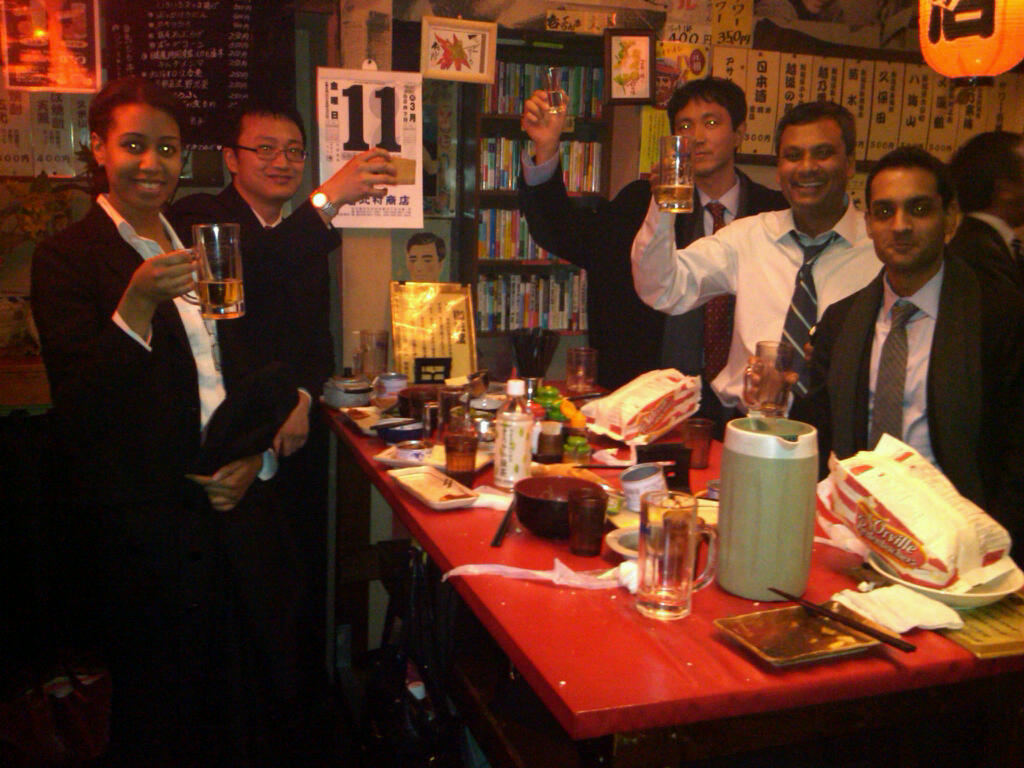
8:00pm: We expire the bar’s 2 hour limit for occupying a table. We decide to check out the subways and start our walk home. The temperature has decidedly dropped and it is close to 40F. Andy and Keith did not bring their coats, and we quickly realize that there are no cars, taxis or subways available. Walking is a possibility, and Samina is happy to try, but given her pregnancy, we realize that we need another option.
8:30pm: Fumi is able to convince a random person driving a car to take Samina, Catherine and Keith to the hotel. Ms. Harami is an angel in disguise, and agrees to go the 6 km out of her way. She is the first person to agree to make the trip after Fumi has tried flagging a full taxi, a police car and a TV crew. (Point C)
9:00pm: Team B (Fumi, Andy, Deep and I) are all relieved that Team A (Catherine, Samina and Keith) will reach the hotel soon and perhaps can send a car to pick us up. We head out to walk towards the hotel and perhaps have more food and beer along the way.
Act 3: Parting Ways
9:30pm: Team B finds out that the Ginza line is working sporadically. We jump on the subway only to have the car go one stop and no further. We get out and start walking around the area of the IMS office (Point E) towards the hotel. On the way we find a Shinto bird shrine and several restaurants that are full. We finally settle in a wonderful rame noodle place.
10:00pm: Team A has traveled 1 km and then gets stuck in gridlock traffic (right at the corner of Chiyoda park).
11:00pm: After ramen and more beer, Team B tries for the subway again. Gets on the Ginza line and makes it to about 2km from the hotel.
12:00pm: Team A has traveled 10m in the car after 2 hours.
Saturday, March 12
12:30am: Team B finally arrives at the hotel (Point B). We declare victory only to finally reach Team A by phone and find that they still have not moved from where they were 3 hours ago.
1:30am: Ms. Harami after 4 hours in the car and moving half a kilometer decides to turn around and take Team A to her daughter’s apartment.
2:30 am: Team A arrives at Ms. Harami’s daughter’s house.
Act 4: Reunion
2:00am: Team B at the hotel realizes that they have to pick up the remaining team. (No consultant left behind). We leave the hotel and start walking to town center in the hopes of finding a taxi, since all the rental cars and hotel cars are unavailable or sold out. Luckily we flag down a cab and start hurtling towards Ms. Harami’s apartment (Point A). The traffic is fine towards downtown, the other direction is still at a stand still.
2:30am: While in the cab, Michele connects a call from Catherine’s mom phoning from DC and wondering why her daughter is at a random person’s home in the middle of Tokyo without anyone that speaks Japanese from the team. The question is completely valid.
3:00am: Team B finds Ms. Harumi’s daughter’s apartment. Everyone is back together again, but we still have to get back to the hotel through the grid-lock traffic. We decide the best thing to do is wait for the subways to start again at 5am. We decide to walk to towards the Tsijuku Fish market.

4:00am: Incredibly no restaurants are open in the market yet. They only open at 5:30am. The market is bustling even though it is just 12 hours after the earthquake. The world fish market keeps moving.


5:00 am: We catch the subway

5:45am: We finally arrive at the Westin

Act 5: Aftermath
On Sunday a few days after the quake, the tremors keep coming yet Tokyo is functioning normally. It will take time for the country to heal, and the death toll is to be determined; and yet one knows that the country that survived two nuclear bomb attacks will make it through thanks to the generosity and grace of its citizens.

March 13, 2011
Subscribe to:
Posts (Atom)